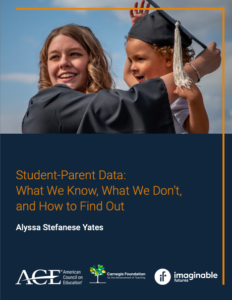
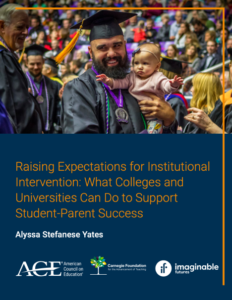
As part of the work to reimagine the Carnegie Classifications and design the Student Access and Earnings Classification, we received support to examine specific topics and concepts that could inform methodological and data decisions. One of those was exploring how colleges and universities support the social and economic mobility of student-parents.
Data show that approximately one in five undergraduates in the United States—over 3.1 million students—are pursuing higher education while they are parenting at least one child or dependent. Student-parents have historically been overlooked and underserved by postsecondary institutions, and they face challenges in persisting to complete degrees when compared with their nonparenting peers.
These papers capture our initial research and understanding of student-parents’ experiences in higher education, what data are available, and how institutions can help mitigate the common challenges that student-parents encounter in pursuing their degree or credential. They were informed by literature and data as well as a convening of institutional leaders, state policymakers, and other key stakeholders that we hosted in September 2024.
While we determined that data on student-parents is not yet ripe for inclusion in the Carnegie Classifications, this body of work helped to inform the overall approach we took in the new classification system.